
Entry criteria
-

Membership
The practice principal architect and at least 20% of the practice’s staff must be RIAS/RIBA members or members of an equivalent overseas professional body.
-
Location
To enter the RIAS Awards, the projects must be located in Scotland. All RIAS Award-winning projects are considered for a RIBA National Award alongside the rest of the UK.
-

Completion
Projects must have been completed between October 2024 and January 2026.
-

Occupation
Projects must have been occupied by January 2026 at the latest (12 months before entries to the 2027 Awards close). Partially-occupied projects are subject to RIAS approval.
-

Client Approval
Entrants must have client permission to submit the project.
-

Sustainability
Projects must meet our sustainability criteria, including actual energy data and water usage.
Your 2027 RIAS Awards submission
A step-by-step guide on what to expect
-
Project name (the title used to identify and refer to your project. Please ensure it doesn't reveal the location, client identity, or other sensitive information)
Project address
Gross and net internal area in square metres
Construction cost
Planning approval, completion and occupation date
Practice name credit for publication
-
Architect practice/studio address
How to contact project director/architect and client
Photographer details
-
Project Summary (150 words)
Provide a brief overview of your project, written in the third person.
If your project receives an award, this summary may be published by RIAS and RIBA. Do not include any information that you or your client wish to remain confidential.
Project Description (350 words)
Pleas explain:
the client brief
design approach
materials
method of construction, programme, and planning
any budget constraints
how the project contributes to its environment, occupants and wider society.
This description will be used during jury deliberations and may inform press coverage. Focus on the aspects of the project that are most important to understanding its architectural quality and impact.
Please do not repeat your Project Summary text here.
Inclusive Accessibility Statement (100 words)
Does the project take into consideration inclusive and accessible design features that go above minimum standard and benefit a range of users with different needs?
Explain any access strategy and inclusive design outcomes. How have the needs of a diverse range of users been met and how has further adaptability in the future been considered?
Examples can include:
appointing an Inclusive Design Lead
using the Inclusive Design Overlay to the Plan of Work across various stages
an established EDI Policy reflected in your project work
-
Please ensure that all key project contractors and consultants are accurately credited.
All listed team members will be acknowledged on the RIBA website, and in the RIAS Review.
-
x10 press images
These will be used for judging, press, website and social media purposes.
Please include a mixture of exterior and interior, and context and detail images, as appropriate.
x10 additional images
These are optional and will only be used for judging purposes.
x5 existing site images.
Please note, all images should meet the following criteria:
High-res JPEG or GIF format (max. 10MB per image) with the exception of existing site images.
Minimum 1000px wide × 700px high
Use individual images only – no montages or composite boards
Do not brand, caption, frame or otherwise alter photographs
File names must not contain special characters (e.g. * % + ©) and should be under 30 characters
Photographs must show the completed built project
Computer-generated renders and AI-generated images will not be accepted
You must supply photographer credits for all submitted images. Each image file should indicate practice name, project name and photographer, i.e. “architect - project (c) photographer”.
By submitting photography, you are agreeing to its use by the RIAS and RIBA for these awards (and any related) processes. Please note that images of shortlisted projects will be shared with external press, so copyright consent is required and is entirely the responsibility of submitting practices.
-
Each entry must include 6 drawings (including plans) in JPEG format (max 2MB each).
Practices are welcome to submit model pictures, where available.
-
Please refer to the Sustainability tab for detailed information on the 2027 RIAS Award requirements.
Payments
Payments must be made online in GBP using a valid credit or debit card with your submission.
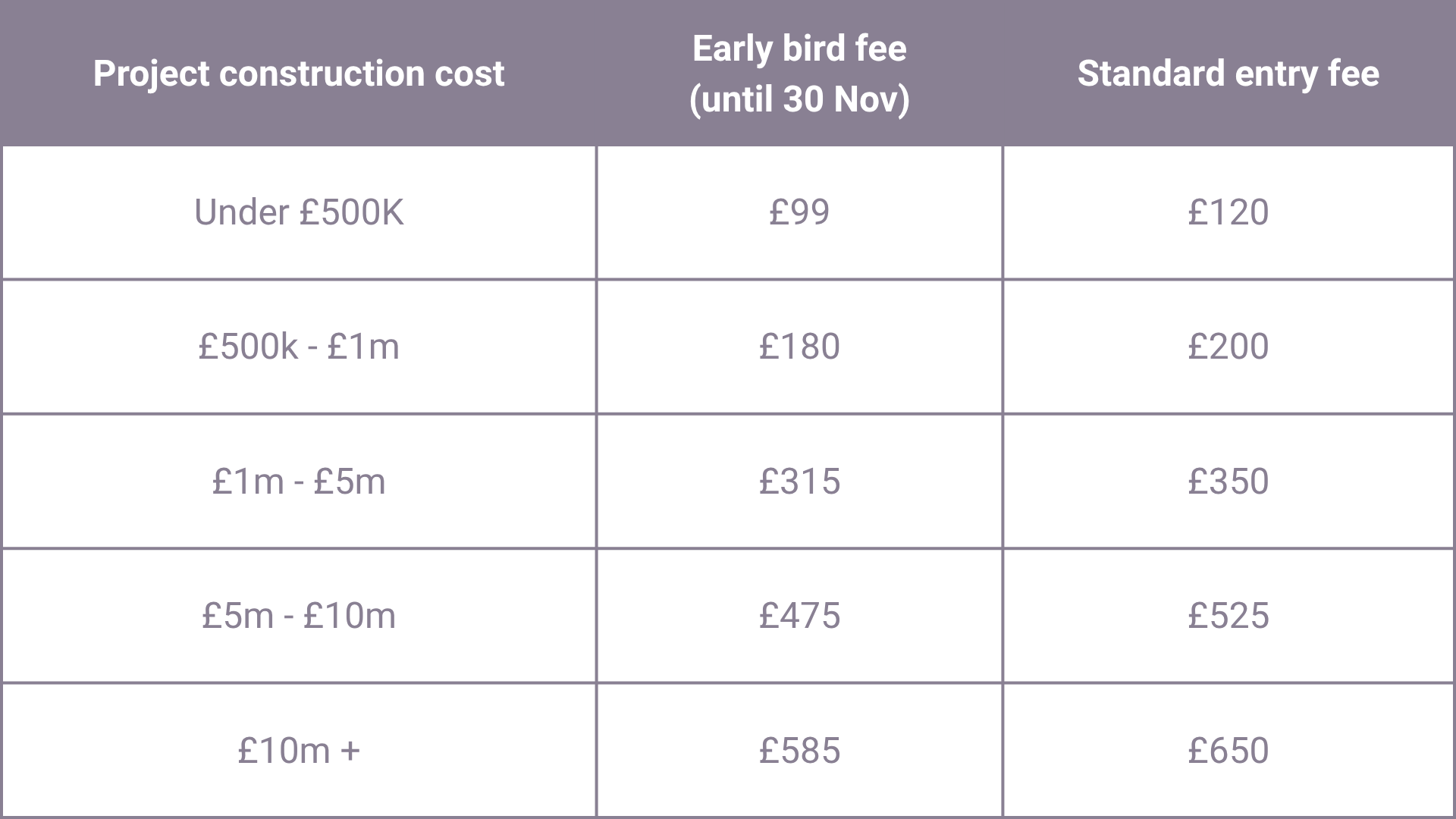
The entry fee is dependent on the construction cost of the project entered. Entry fees do not include VAT.
Financial support
We offer financial support via discounted or free entry for architects and practices without the financial resources to enter our 2027 RIAS Awards programme.
To ask about or apply for financial support, please email awards@rias.org.uk for more information. Applications will be considered on a case-by-case basis.
Judging
Judging Process
After entries close our panel of judges will have an inperson meeting to discuss the submissions.
No project is awarded without being visited in person, ensuring every decision is grounded in first-hand experience.
These visits are typically carried out in March and due to a tight time schedule it is not always possible to rearrange to specific architect or client requests.
If shortlisted for an award, your project will be visited including
a 1 hour guided tour of the project
representatives from the client and design team
discussion with building users where appropriate
Make sure:
the building is presented at its best
users and clients can speak authentically about it
key aspects of the design can be experienced during the visit
jurors visiting housing projects are able to access at least one dwelling
In person visits
Judging Criteria
Judges will assess projects on their architectural quality, conceptual ambition, innovation, sustainability, material selection, detailing and potential for future adaptability. Consideration will also be given to the project’s usability, accessibility, response to its context, contribution to the surrounding environment and social value. The judging process will further consider the complexity of the brief, fitness for purpose, client satisfaction, quality of delivery, programme and value for money.